How to Come Fare Esercizio Senza Attrezzi: A Complete Guide
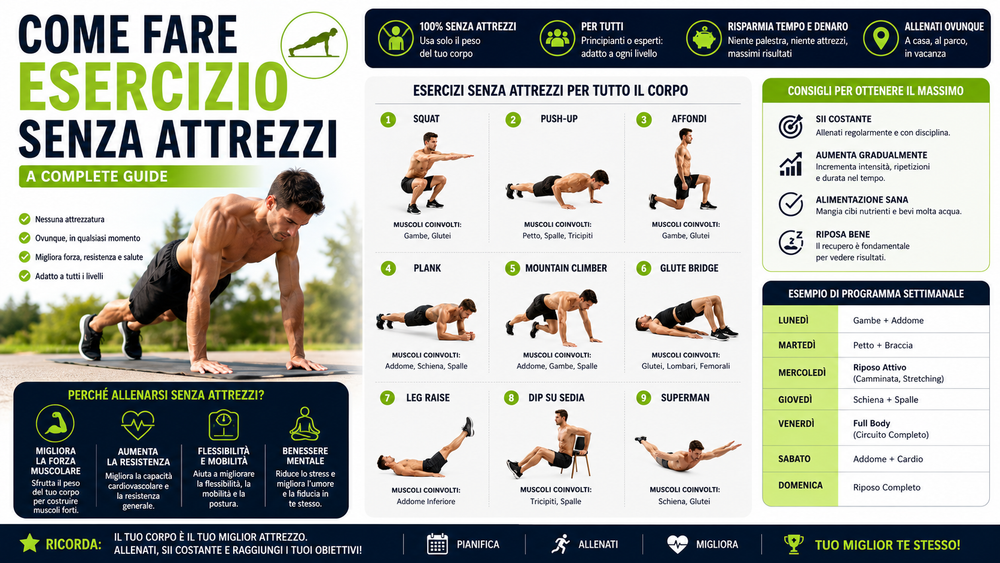
Staying fit does not necessarily require a gym membership, expensive machines, or a collection of weights. If you are wondering Come Fare Esercizio Senza Attrezzi, which means “how to exercise without equipment,” there are many simple and effective bodyweight exercises you can do almost anywhere.
Bodyweight workouts are convenient, affordable, and suitable for different fitness levels. Whether you want to improve your strength, endurance, flexibility, or overall fitness, you can create an effective workout routine using nothing more than your own body weight and a small amount of space.
In this guide, we will explore some of the best exercises without equipment and explain how you can create a simple workout routine at home.
Why Exercise Without Equipment?
One of the biggest advantages of exercising without equipment is convenience. You do not need to travel to a gym or purchase expensive fitness equipment. You can work out in your bedroom, living room, backyard, or even outdoors.
Bodyweight exercises can target almost every major muscle group. They can help improve strength, balance, coordination, mobility, and cardiovascular fitness when performed regularly.
Another important benefit is flexibility. You can choose exercises according to your fitness level and adjust the number of repetitions, sets, and rest periods as you become stronger.
How to Start a Bodyweight Workout
Before beginning your workout, spend a few minutes warming up. A warm-up can include walking in place, gentle arm movements, hip rotations, and other dynamic movements.
A beginner-friendly workout can take around 20 to 30 minutes. You do not need to exercise for hours to make progress. Consistency is often more important than having extremely long workouts.
A basic workout can combine lower-body exercises, upper-body movements, core exercises, and cardiovascular activities. Take short breaks between exercises whenever necessary.
Squats for Stronger Legs
Squats are one of the most popular bodyweight exercises. They primarily work the thighs and glutes while also requiring stability from the core.
To perform a basic squat, stand with your feet approximately shoulder-width apart. Keep your chest lifted and slowly push your hips backward while bending your knees. Lower yourself as if you were sitting on a chair, then return to the starting position.
Beginners can start with two or three sets of 8 to 12 repetitions. As your strength improves, you can gradually increase the number of repetitions or try more challenging squat variations.
Push-Ups for the Upper Body
Push-ups are an excellent exercise for training the chest, shoulders, and triceps. They also require your core muscles to stabilize your body.
Start in a position with your hands on the floor and your body extended. Keep your body relatively straight as you bend your elbows and lower your chest toward the floor. Push through your hands to return to the starting position.
If traditional push-ups are difficult, beginners can perform them with their knees on the floor or against a sturdy elevated surface. Focus on controlled movement rather than performing as many repetitions as possible.
Lunges for Legs and Glutes
Lunges are another useful exercise if you want to learn come fare esercizio senza attrezzi. They work the legs and glutes while also challenging balance and coordination.
Begin by standing upright. Take a controlled step forward with one leg and bend both knees. Lower your body comfortably, then push through the front foot to return to the starting position. Repeat with the opposite leg.
Start with a small number of repetitions on each side and increase gradually as your balance and strength improve.
Planks for a Stronger Core
The plank is a simple exercise that can strengthen and stabilize the core. Unlike many traditional exercises, the plank involves holding your body in a stable position rather than repeatedly moving.
To perform a basic plank, place your forearms and toes on the floor and keep your body as straight as comfortably possible. Avoid allowing your hips to drop too low or rise too high.
Beginners can start with short intervals, such as 15 to 30 seconds. Over time, you can gradually increase the duration as your core becomes stronger.
Jumping Jacks for Cardio
Jumping jacks are an easy way to add cardiovascular activity to a bodyweight workout. They increase your heart rate while involving your arms and legs.
Start standing with your feet together and your arms by your sides. Jump while moving your feet outward and raising your arms overhead. Then return to the starting position.
If jumping is uncomfortable, you can perform a low-impact variation by stepping one foot outward at a time while moving your arms.
How to Create a No-Equipment Workout Routine
You can combine several exercises to create a simple full-body circuit. For example, try the following routine:
- Squats: 10–15 repetitions
- Push-ups: 6–12 repetitions
- Lunges: 8–10 repetitions per leg
- Plank: 20–30 seconds
- Jumping jacks: 20–30 seconds
Complete the exercises one after another, resting briefly when necessary. After finishing the circuit, take a longer rest and repeat it two to four times depending on your fitness level.
You can also create different routines on different days. For example, one workout can focus more on strength, while another can emphasize mobility or cardiovascular exercise.
How to Make Your Workout More Challenging
As your body adapts to exercise, you may need to gradually increase the difficulty. You do not necessarily need weights or equipment to do this.
You can increase the number of repetitions, add another set, reduce rest periods slightly, or perform a more challenging variation of an exercise.
For example, once regular squats become easy, you can add a pause at the bottom of each repetition. Similarly, you can progress from modified push-ups to traditional push-ups as your upper-body strength improves.
The goal should be gradual progression rather than trying to make every workout extremely difficult.
Common Mistakes to Avoid
One common mistake is focusing too much on the number of repetitions and not enough on technique. Performing fewer repetitions with controlled and proper form is generally better than rushing through a large number of repetitions.
Another mistake is starting with an overly intense workout after being inactive for a long period. Gradually increasing your activity can make it easier for your body to adapt.
Recovery is also important. Give your muscles enough time to recover between demanding workouts. Adequate sleep, hydration, and a balanced diet can also support your overall fitness routine.
If you experience significant pain during exercise, stop the movement and seek appropriate professional advice.
How Often Should You Exercise Without Equipment?
How often you should exercise depends on your fitness level, goals, schedule, and other physical activities.
If you are a beginner, starting with a few workouts per week can be a practical approach. As your fitness improves, you can gradually increase your activity.
The most important factor is consistency. A simple workout routine that you can maintain regularly is often more sustainable than an extremely demanding program that you cannot follow for long.
You can also increase your daily physical activity by walking more, taking the stairs when appropriate, and taking regular movement breaks if you spend a lot of time sitting.
Conclusion
Learning come fare esercizio senza attrezzi shows that you do not need a gym or expensive equipment to become more active. Exercises such as squats, lunges, push-ups, planks, and jumping jacks can form the foundation of a simple and effective bodyweight workout.
The key is to start at a comfortable level, focus on proper technique, and gradually increase the challenge as your fitness improves. With consistency and a balanced approach, exercising without equipment can become an easy and sustainable part of your daily routine.