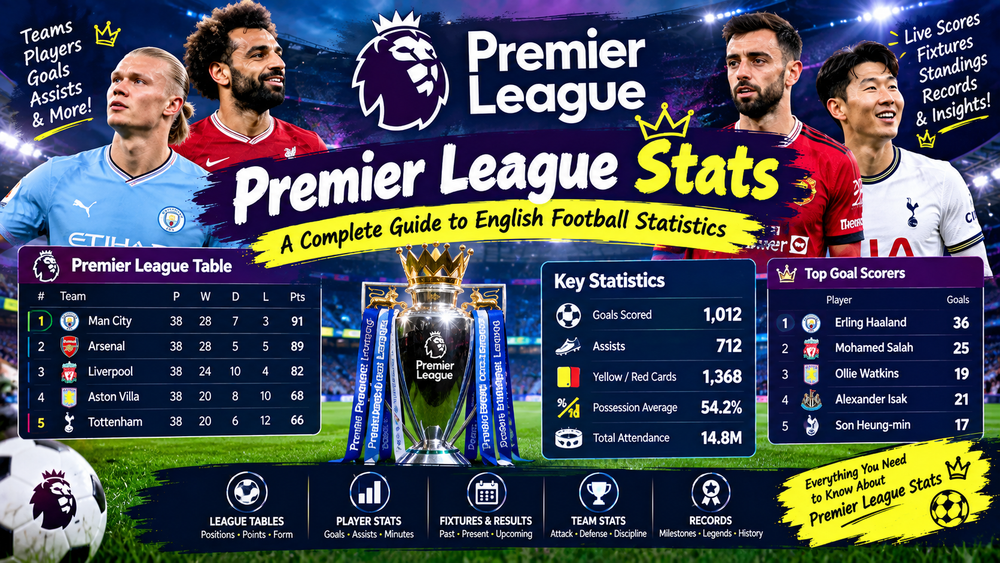
Premier League Stats: A Complete Guide to English Football Statistics
The Premier League Stats is one of the most popular and competitive football leagues in the world. Millions of fans follow every match, goal, assist, clean sheet, and league-table change throughout the season. Premier League stats provide a detailed way to understand team performances, player achievements, and important trends across the competition.
Whether you are a football fan, fantasy football player, sports analyst, or simply someone who enjoys following English football, statistics can make every match more interesting. From goals and assists to possession and expected goals, Premier League statistics offer valuable insight into what happens on the pitch.
What Are Premier League Stats?
Premier League stats are numerical records that measure different aspects of football matches and performances. They can cover individual players, teams, individual games, or an entire season.
Common statistics include:
- Goals scored
- Assists
- Shots and shots on target
- Passes and passing accuracy
- Possession
- Tackles
- Interceptions
- Fouls
- Yellow and red cards
- Clean sheets
- Saves
- Expected goals (xG)
- Expected assists (xA)
- Wins, draws, and losses
These statistics help supporters look beyond the final score and understand how a team or player performed.
Important Premier League Team Stats
Team statistics are particularly useful when comparing clubs during a season. The league table itself provides basic information such as points, wins, draws, losses, goals scored, and goals conceded.
Some of the most important team stats include:
Goals Scored
Goals scored show how effective a team has been in attack. A high-scoring team may have several productive forwards, creative midfielders, or an effective attacking system.
Goals Conceded
Goals conceded indicate how well a team has defended. Clubs that consistently limit opposition goals generally have strong defensive organization and reliable goalkeeping.
Goal Difference
Goal difference is calculated by subtracting goals conceded from goals scored. It can be an important indicator of overall performance and is also used as a league-table tiebreaker when teams have the same number of points.
Possession
Possession statistics show how much time each team controls the ball. However, having more possession does not automatically mean a team will win, making it useful to consider possession alongside shots, chances, and goals.
Key Premier League Player Stats
Player statistics allow fans to compare individual performances throughout the season. Different positions require different measurements, so the most useful statistics depend on a player’s role.
Important player stats include:
- Goals
- Assists
- Minutes played
- Shots
- Shots on target
- Key passes
- Pass completion
- Tackles
- Interceptions
- Clearances
- Saves
- Clean sheets
For forwards, goals and assists are often closely followed. Midfielders may be evaluated through passing, chances created, ball recoveries, and assists, while defenders are often measured through tackles, interceptions, clearances, and defensive actions.
Premier League Goals and Assists
Goals and assists are among the most popular Premier League statistics. Goals directly determine match outcomes, while assists show a player’s contribution to creating scoring opportunities.
The Premier League’s leading scorers are often among the most closely followed players in world football. Fans can use scoring statistics to compare strikers, attacking midfielders, and other players who regularly contribute to goals.
Assists are also important because they demonstrate creativity. A player may not score frequently but can still have a major influence by consistently creating chances for teammates.
Advanced Premier League Stats
Modern football analysis goes beyond traditional statistics. Advanced metrics can provide a more detailed picture of team and player performance.
Some commonly used advanced statistics include:
- Expected goals (xG)
- Expected assists (xA)
- Progressive passes
- Progressive carries
- Shot-creating actions
- Pressures
- Touches in the penalty area
- Defensive actions
- Big chances created
Expected goals (xG) estimates the likelihood that a particular shot will result in a goal based on factors such as location, type of chance, and other characteristics. It can help analysts understand whether a team’s scoring record reflects the quality and quantity of its chances.
Premier League Defensive Stats
Defensive statistics are essential when evaluating teams and players. A clean sheet is one of the simplest defensive measurements, but it does not tell the entire story.
Other defensive statistics include:
- Tackles
- Interceptions
- Blocks
- Clearances
- Recoveries
- Defensive duels
- Aerial duels
- Saves
- Goals conceded
- Clean sheets
Goalkeepers have their own important statistics, including saves, save percentage, goals conceded, and clean sheets. Looking at several measurements together provides a more complete understanding of defensive performance.
Premier League Stats for Fantasy Football
Premier League statistics are extremely useful for fantasy football. Fantasy managers regularly examine player form, minutes, goals, assists, fixtures, and defensive records before making decisions.
Useful fantasy football statistics can include:
- Goals and assists
- Minutes played
- Shots
- Chances created
- Clean sheets
- Saves
- Bonus-point performance
- Set-piece involvement
- Penalty involvement
Statistics can help fantasy managers identify players who are consistently involved in attacking or defensive actions rather than relying only on reputation.
Why Premier League Stats Matter
Statistics give football fans a more objective way to examine performances. A match may finish 1–0, but the statistics can reveal that the winning team created many more chances or that the losing goalkeeper made several important saves.
Stats are also valuable for:
- Comparing players
- Analyzing team tactics
- Tracking player development
- Studying historical performances
- Supporting fantasy football decisions
- Understanding match trends
- Evaluating attacking and defensive efficiency
However, statistics should be interpreted alongside context. A player’s numbers can be affected by injuries, playing time, team tactics, opposition quality, and their specific position.
How to Find Reliable Premier League Stats
When searching for Premier League statistics, it is important to use reliable and regularly updated sources. Official competition statistics and established football-data platforms can provide information about matches, players, and teams.
When comparing statistics, check:
- The season being analyzed
- The number of matches played
- Whether the statistic is per match or total
- The player’s minutes played
- The player’s position
- The source and methodology
- Whether the data is updated
This prevents misleading comparisons between players or teams with different amounts of playing time.
Conclusion
Premier League stats provide a detailed view of English football, covering everything from goals and assists to possession, defensive actions, and advanced metrics such as expected goals. They allow fans to understand performances beyond the final score and make informed comparisons between players and teams.
Whether you are following the league casually, researching football history, analyzing tactics, or managing a fantasy football team, statistics can add another level of understanding to the game. By combining traditional numbers with advanced metrics and appropriate context, Premier League statistics offer a powerful way to explore the world’s most watched domestic football competitions.